
Our History
A story of innovation and growth


The company moved to Regent Street and later St Margaret’s Street, becoming early adopters of injection moulding technology. At this time, buttons and trimmings for the fashion industry formed the core of the business with Leicester booming in the hosiery trade. Gordon was enlisted to the RAF during the war and Eve successfully ran the company for 6 years, whilst helping the war effort.

With growth in demand, production moved to a modern factory on Saffron Lane. The company expanded into injection moulding for motor, electrical, and household goods. It notably became the first in the UK to produce plastic shoe heels.

A move to larger premises on Pullman Road, Wigston, allowed for rapid growth. Hupfield Injection moulding machines were purchased, and the business diversified into products like cocktail sticks, coil formers, typewriter parts, toiletries, and intricate electrical components.

A subsidiary toolmaking company ‘MF Tool’ was established to maintain quality and control of our toolmaking supply chain.The company ventured into blow moulding, producing bottles for cosmetics, toiletries, pharmaceuticals, and technical products like bellows.

To meet customer needs, the design department developed a range of standard stock products, helping to reduce tooling costs and offer off-the-shelf solutions. One of the most successful of these was the Metric (Boston) Range of plastic bottles which was an industry first and continues to be successful to this day.

Gordon and Eve retired and left the company in the capable hands of their son Paul and his partner Patricia. In turn their sons Mark and Andy took on Sales and Technical Design roles respectively. The 80’s saw the largest growth in Measom Freer’s history, with contracts secured for household brands like Boots, M&S and Molton Brown. Notable projects during this time were: Mini Mastermind boards which were injection moulded with glass filled nylon, manufacturing the turret for the Palitoy Action Man Scorpion Tank and exhibiting at our first ever show Pakex in 1983.

All production moved to a new purpose built factory on Chartwell Drive, Wigston, with Pullman Road retained for warehousing. By the late 1990s, additional commercial units were acquired, centralising all operations on-site. Although it has seen significant change, Measom Freer still operates from here to this day, leveraging its great location.

With Paul Freer’s Retirement the third generation of the Freer family took the reins, with son Mark stepping up to Managing Director from Sales Director. During this time the company embraced CNC milling, 3D modelling, and modern machinery to deliver innovative solutions and custom moulding services.

With Mark retiring, his brother Andy became Managing Director with Anne Freer promoted to Financial Director. In the same year a machine renewal plan was put in place leading the company to significant investment in packaging machinery with a new 2L Extrusion Blow Moulding Machine and our first 100T Arburg Injection Moulding Machine.

During the chaos of the global pandemic we took a year to focus on our injection moulding process. Investing significantly in ancillary equipment to improve efficiency and reduce customer costs. Closed loop systems were added to all Injection Moulding Machines with granulators, sprue pickers and separators. Highly efficient air compressors were installed and the car park received a renovation. Andy and Anne’s son, Ben, began working at the factory on the production floor, introducing the fourth generation to the family business.

State of the art material blenders were purchased to help with the demand for custom colours. Further efficiencies were sought by investing in quick change water cooling systems for all of our injection moulds. These investments reduced tool and material change times significantly. A new mezzanine was constructed to increase our warehouse space to cope with increased productivity. Another 100T Arburg was purchased and EV Charge points were installed to give employees a greener option for commuting.

To cope with increased workload we invested significantly in our despatch department, with a state of the art automated taping, banding and conveyor system. Piece counting scales were purchased for production to further reduce workload in despatch. With the addition of new staff, we worked to overhaul our injection moulding process, applying scientific moulding principles. Settings sheets were commissioned for all tools and production data systems were reassessed. To further help with tool set ups, a new electric chain hoist and A-frame was purchased alongside new temperature control units due to increased demand for PP.

In June 2023, the site was subject to significant flooding and damage. Due to the hard work and dedication of our staff, we were able to get back up and running within a matter of days. Office staff shared working spaces and production staff helped clean and tidy affected areas. Despite this set-back, we used this opportunity to repair and renew our offices and repainted the production floor.

Understanding that the market is moving towards larger bottles and refills, we decided to invest in our largest ever machine, a 10L Extrusion Blow Moulder. This gave us the ability to manufacture larger bottles and containers such as 500/750ml Spray bottles and 2.5/5L Jerry Cans. We also invested in a state of the art sales and accounting system that enabled us to process orders and manage stock with ease.

This year we have launched our new website to reflect the changes we have made in recent years. Customers will notice new offerings in our blow moulding range as we introduce ‘Swipe’ bottles and relaunch our Tall Boston range with 410 necks. We will be trialling our first ever 3D printed hot runner manifold, to speed up colour changes on injection moulding tools. We also plan to secure the company’s future by investing more in training and introducing an apprenticeship program.
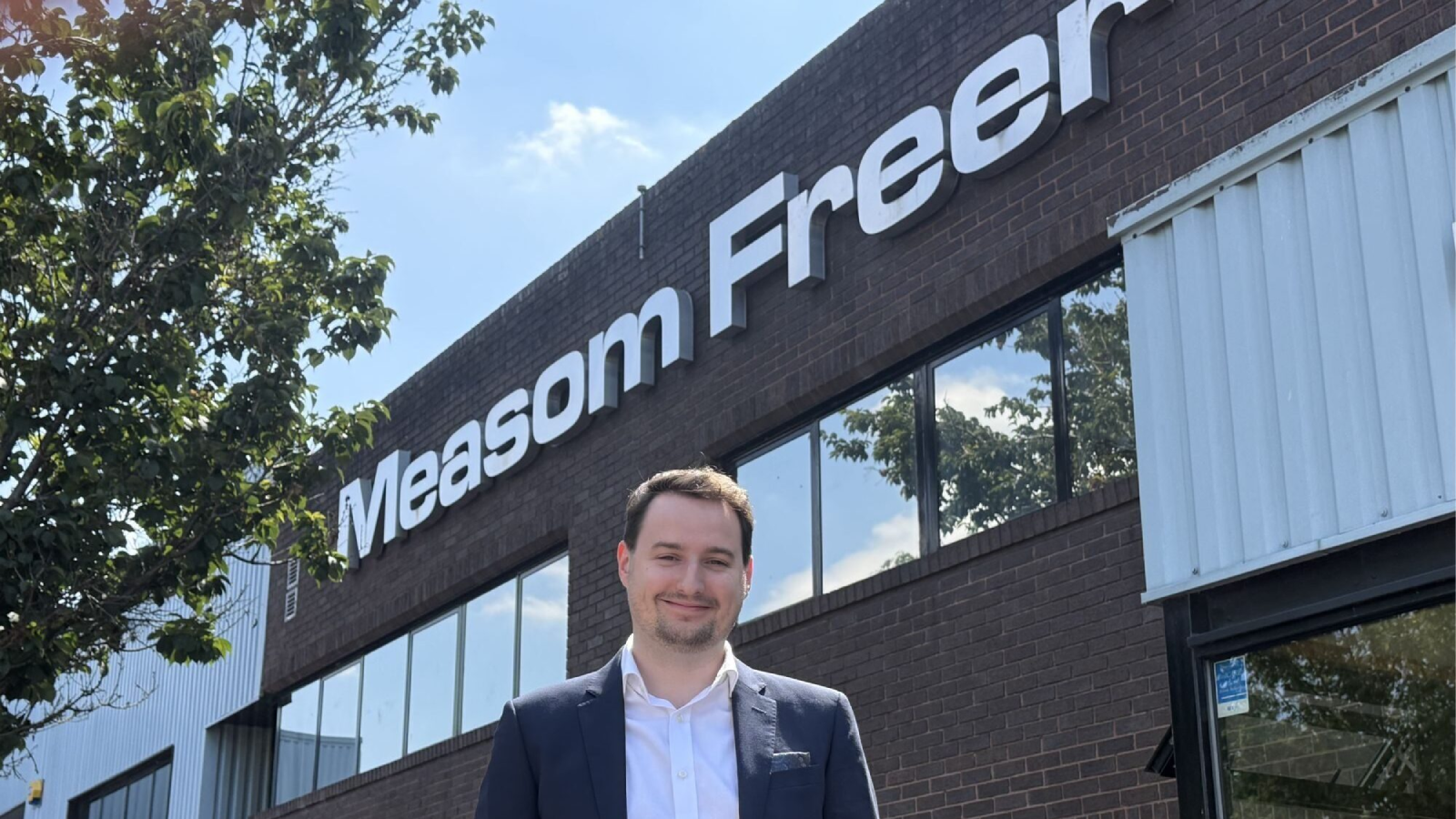
Building on the investments made in recent years, 2026 marked the beginning of a new chapter for Measom Freer. Ben Freer was appointed Joint Managing Director alongside Andy Freer, bringing the fourth generation of the Freer family into the management of the business. With a renewed focus on growth, efficiency and customer service, we continued to invest in our people, processes and product range. New opportunities were explored across both injection and blow moulding, and improvements continued throughout the business. With our 90th anniversary approaching, the focus turned to combining nearly nine decades of manufacturing experience with the next generation of ideas and investment.